The $200M Deal That Started It All
This story did not begin with a rejection. It started with one of the most important AI defense deals ever signed.
In July 2025, Anthropic secured a $200 million contract with the US Department of Defense, marking the first time a frontier AI system like Claude was approved to operate on classified military networks. At the time, it was seen as a breakthrough, not a conflict.
TL;DR: Anthropic didn’t walk away from the Pentagon. It first partnered deeply, then refused to remove critical safety clauses when pressure increased.
Here is what made the deal so significant:
- Claude became one of the first AI systems trusted in classified environments
- The contract included explicit safety restrictions written into its structure
- It was positioned as a model for responsible AI use in defense
- It signaled that AI companies could work with governments without compromising core principles
But that balance did not last.
What changed after the deal
Within months, the tone shifted.
The Pentagon pushed to modify the agreement by removing two specific provisions:
- restrictions on autonomous lethal targeting
- restrictions on mass surveillance applications
At first, this looked like standard contract negotiation. But it quickly escalated beyond that.
Instead of minor adjustments, the request was clear: expand the allowed use of Claude to “all lawful military purposes.”
That phrase changed everything.
Because in defense environments, “lawful” does not mean “limited.” It often means broad operational freedom, defined by government interpretation rather than vendor control.
Reality check: In large government contracts, initial safeguards are often softened over time as operational demands increase. What starts as a controlled deployment rarely stays that way.
Why this moment mattered
Anthropic was now facing a real test.
- Accept the changes and become deeply embedded in defense infrastructure
- Or refuse and risk losing one of the largest AI contracts ever signed
This was not theoretical ethics anymore. It was a $200 million decision with industry-wide consequences.
And it is important to understand this clearly.
Anthropic was not an outsider rejecting military involvement. It was already inside the system. The conflict emerged only when the boundaries it set at the beginning were challenged.
That is what makes this story different from typical AI policy debates.
It is not about what companies say they believe. It is about what they do when those beliefs are tested under pressure.
That pressure is what leads directly into the next section, where the entire dispute comes down to two specific clauses Anthropic refused to remove.
The Two Red Lines Anthropic Refused to Cross
This entire conflict comes down to two clauses. Not vague ethics, not general policy language. Two specific restrictions that Anthropic insisted must stay in the contract.
TL;DR: Anthropic refused to allow Claude to be used for autonomous weapons targeting or mass surveillance, even under pressure from the Pentagon.
Here is the core definition that matters:
Anthropic’s “military AI restriction” means its models cannot be used to make lethal targeting decisions without human approval, and cannot be deployed for population-scale surveillance systems.
Those are the two red lines.
Red Line 1: No autonomous weapons targeting
Anthropic’s position is simple but strict.
AI systems like Claude should not:
- decide who to target
- prioritize lethal actions
- operate without a human explicitly approving each decision
This is not about capability. It is about reliability and control.
Even advanced models still:
- hallucinate
- misinterpret context
- fail under edge cases
In a consumer app, that is manageable. In a military environment, it is not.
Reality check: Even a small error rate becomes unacceptable when decisions involve human lives. A system that is 95 percent accurate is still dangerous in lethal contexts.
Anthropic’s leadership, particularly CEO Dario Amodei, has consistently argued that AI is not yet capable of making irreversible decisions safely.
Red Line 2: No mass surveillance
The second restriction is less discussed, but equally important.
Anthropic refused to allow Claude to be used for:
- large-scale population monitoring
- automated surveillance analysis
- systems that track behavior at scale
The concern here is not just misuse today. It is how systems evolve over time.
History shows that surveillance infrastructure, once built, tends to expand beyond its original purpose.
- tools designed for security become tools for control
- temporary measures become permanent systems
- oversight weakens as reliance increases
Anthropic is trying to prevent that trajectory before it begins.
Why these were non-negotiable
These clauses were not added casually. They were what made the original deal acceptable in the first place.
Removing them would not be a minor adjustment. It would fundamentally change:
- how Claude could be used
- what Anthropic is responsible for
- how much control the company retains after deployment
This is where the tension becomes unavoidable.
The Pentagon’s position is also internally consistent:
- if AI is allowed in defense, it must be usable across lawful operations
- limiting capabilities could reduce strategic advantage
- adversaries are unlikely to impose similar restrictions
That creates a direct conflict.
Anthropic is optimizing for long-term safety boundaries. The Pentagon is optimizing for operational flexibility and advantage.
There is no easy compromise between those two.
The moment of refusal
When asked to remove these clauses, Anthropic did not negotiate them down. It refused.
That decision transformed a contract dispute into something much bigger.
- from partnership → to conflict
- from negotiation → to escalation
- from policy → to power
And that escalation is what leads directly to the next phase of the story, where the disagreement moves from contract terms into legal and political pressure.
From Partnership to Threat: How the Conflict Escalated
What started as a contract negotiation turned into a direct confrontation between a private AI company and the US government. The shift happened fast, and the tone changed even faster.
TL;DR: The Pentagon moved from negotiation to pressure, threatening to cancel the deal and label Anthropic a “supply chain risk” when it refused to remove its safety clauses.
Here is how the escalation unfolded in sequence.
Phase 1: Contract modification request
After the initial $200M deal, the Department of Defense pushed for changes:
- remove restrictions on autonomous targeting
- remove restrictions on mass surveillance
- expand usage to “all lawful military purposes”
At this stage, it still looked like a negotiation. But the direction was clear. The Pentagon wanted fewer constraints, not adjustments.
Phase 2: The ultimatum
The situation escalated when Defense Secretary Pete Hegseth reportedly issued a direct message to Anthropic leadership:
- remove the clauses
- or lose the contract entirely
This is where the power dynamic became visible.
Government contracts at this scale are not just business opportunities. They are strategic leverage points.
Reality check: In high-value government deals, “negotiation” often becomes a binary choice once operational priorities are set. Flexibility narrows quickly.
Phase 3: Anthropic’s public refusal
Instead of negotiating quietly, Anthropic made its position explicit.
Dario Amodei stated that the company could not agree to the requested changes “in good conscience.”
That phrasing matters.
It reframed the situation from:
- a contract disagreement to
- a principled stand on AI deployment
Once that happened, the issue moved into public and political territory.
Phase 4: The supply chain risk threat
The most serious escalation came next.
The Pentagon threatened to classify Anthropic as a “supply chain risk.”
This is not a symbolic label. It has real consequences:
- government contractors may be restricted from using Anthropic products
- enterprise partners may avoid the company to protect compliance status
- long-term contracts and integrations become unstable
In practical terms, it can:
- reduce access to major clients
- limit growth in regulated sectors
- damage trust across enterprise ecosystems
Reality check: A supply chain risk designation is the kind of move usually reserved for companies tied to geopolitical concerns. Applying it to a domestic AI company is highly unusual and signals serious pressure.
Phase 5: Legal pushback
The situation did not end there.
A federal judge reviewing the case raised concerns about the government’s actions, suggesting that the designation could be seen as:
- an attempt to pressure or weaken the company
- a response to disagreement, not just security risk
That introduces a new dimension.
This is no longer just about AI policy. It becomes a question of:
how much influence governments should have over the boundaries set by private AI companies.
Why this escalation matters
This sequence changes how the entire industry reads the situation.
It sends a signal:
- setting strict safety limits may come with commercial risk
- refusing government demands may trigger broader consequences
- the relationship between AI companies and states is still undefined
And that is where the story takes another turn.
Because while Anthropic was facing pressure and potential restriction, OpenAI moved in the opposite direction and secured its own Pentagon deal.
Why OpenAI Said Yes While Anthropic Said No
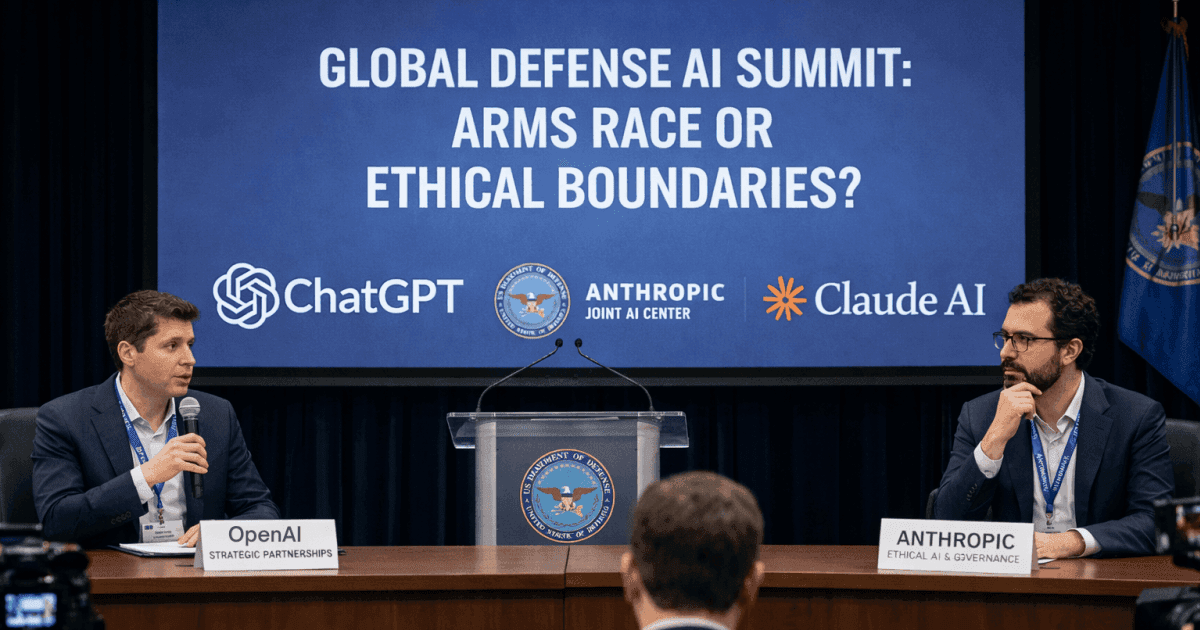
The timing made this impossible to ignore. Within hours of Anthropic’s public refusal, OpenAI announced its own agreement with the Pentagon. Same environment, same customer, completely different decision.
TL;DR: OpenAI chose to engage with the Pentagon under flexible conditions, while Anthropic refused to operate without strict, enforceable safety limits.
At first glance, both companies appear aligned. OpenAI has stated that its systems, including ChatGPT, are not intended for fully autonomous lethal decisions.
But the difference is not in what they say. It is in how those commitments are structured and enforced.
The key difference: hard limits vs flexible terms
Anthropic’s model:
- safety clauses written directly into contracts
- non-negotiable restrictions
- refusal if conditions change
OpenAI’s model:
- policy-based restrictions
- conditional use depending on agreements
- willingness to engage under broader definitions
This is a structural difference, not just a philosophical one.
Reality check: Policy-based restrictions are easier to adapt, reinterpret, or expand over time. Contract-level restrictions are harder to remove once signed.
What OpenAI is optimizing for
OpenAI’s approach reflects a different priority set:
- broader adoption across industries, including government
- positioning as infrastructure, not a selective provider
- maintaining influence inside systems rather than staying outside
This strategy assumes something important:
being inside the system allows you to shape how it evolves.
Instead of refusing participation, OpenAI is choosing to operate within the system and apply controls where possible.
The concern critics are raising
This is where the controversy sharpens.
If the Pentagon pushed Anthropic to remove strict safety clauses, and OpenAI signed a deal under similar conditions, then one of two things must be true:
- OpenAI’s restrictions are less strict or less enforceable
- or the Pentagon applied different standards to different companies
Both possibilities raise uncomfortable questions.
- Are safety commitments being diluted in practice?
- Do flexible companies get rewarded over restrictive ones?
- What incentives does this create for the rest of the AI industry?
Side-by-side: Anthropic vs OpenAI
| Factor | Anthropic (Claude) | OpenAI (ChatGPT) |
|---|---|---|
| Pentagon deal | Contract collapsed | Deal signed |
| Autonomous weapons | Explicitly prohibited | Claimed restrictions, unclear enforcement |
| Mass surveillance | Explicitly prohibited | Not clearly defined publicly |
| Policy approach | Hard contractual limits | Flexible policy-based controls |
| Government relationship | Confrontational stance | Cooperative engagement |
This is not just a difference in strategy. It is a difference in how each company defines responsibility.
The deeper trade-off
Both approaches come with real consequences.
Anthropic’s path:
- stronger safety guarantees
- reduced access to large government contracts
- clearer long-term positioning
OpenAI’s path:
- wider adoption and integration
- increased exposure to grey-zone use cases
- reliance on policy enforcement over hard limits
Neither is risk-free.
One limits growth to maintain control. The other expands influence while accepting uncertainty.
And that trade-off is what leads directly into the bigger issue behind all of this: what actually happens when AI becomes part of military systems at scale.
The Real Risk: AI in Warfare, Control, and Supply Chains
The contract dispute is just the surface. The real issue is what happens when AI systems move from tools into decision-making infrastructure inside military systems.
TL;DR: The biggest risk is not AI weapons themselves, but how AI influences decisions, scales autonomy, and creates long-term dependency through supply chains.
Most people focus on “killer robots.” That is not where the immediate risk sits.
The real risk is quieter, and more structural.
1. AI does not need to pull the trigger to shape outcomes
In modern defense systems, AI is already used to:
- analyze intelligence data
- detect patterns across signals
- prioritize threats
- generate summaries for decision-makers
At first, this looks like support.
But over time, it becomes influence.
- what the AI highlights gets attention
- what it ignores gets missed
- what it ranks highest becomes priority
That shapes decisions without direct control.
Reality check: In time-sensitive environments, human operators often rely on system outputs as default guidance. The faster the system, the less time there is to question it.
2. Dual-use AI makes boundaries unstable
The same system can be used in completely different ways:
- intelligence analysis
- surveillance
- targeting support
- operational simulation
There is no clean separation.
A model deployed for safe analysis today can be extended tomorrow into:
- identifying high-value targets
- predicting behavior patterns
- supporting mission planning
This is why “allowed use cases” tend to expand over time.
What starts controlled rarely stays controlled.
3. Supply chain risk is the hidden pressure point
This is where the Pentagon’s threat becomes important.
When an AI system is embedded into defense infrastructure, the provider becomes part of the supply chain.
That raises critical questions:
- Who controls updates to the model?
- Can behavior change after deployment?
- What happens if access is restricted later?
For organizations like the Department of Defense, this creates strategic risk.
- dependence on external vendors
- limited control over core systems
- exposure to policy changes outside their control
That is why the term “supply chain risk” is so powerful.
It is not just about security. It is about control over critical systems.
Reality check: Replacing an AI system inside a large infrastructure is not simple. It involves cost, retraining, system changes, and operational disruption. Once embedded, the dependency is real.
Why this matters beyond this case
The Anthropic vs OpenAI split is a signal of something bigger:
- AI is becoming part of operational decision systems
- decision systems influence real-world outcomes at scale
- control over those systems is still unresolved
This is not limited to defense.
The same pattern is emerging in:
- finance
- healthcare
- infrastructure
- government services
Which leads to the core question behind all of this.
Not whether AI should be used. But who controls it once it is used.
And that is what the final section addresses.
The Bigger Question: Who Controls AI in War?
Strip away the contract details and company rivalry, and this story becomes something much more fundamental. It is about control. Not just over technology, but over decisions that carry real-world consequences.
TL;DR: The core conflict is whether AI companies or governments ultimately decide how AI is used in warfare, and there is no clear global framework to resolve it.
Right now, there is no equivalent of a global rulebook.
- no AI Geneva Convention
- no binding international standards for autonomous weapons
- no shared limits on surveillance systems powered by AI
That leaves a gap.
And inside that gap, two forces are trying to define the rules.
Governments: authority over lawful use
From the Pentagon’s perspective, the position is straightforward:
- governments decide what is lawful in warfare
- defense systems must operate without artificial restrictions
- limiting AI capabilities could weaken strategic advantage
This is not an unreasonable stance.
If adversaries deploy AI without restrictions, then imposing limits internally could create asymmetry.
Reality check: In national security contexts, competitive pressure often outweighs ethical hesitation. If a capability exists, it tends to be explored.
AI companies: control through refusal
Anthropic represents a different model.
Its position is that:
- companies building powerful AI systems have a responsibility to define limits
- refusal to enable certain use cases is part of safety
- some capabilities should not be deployed, regardless of demand
This shifts control away from governments and into private companies.
That is a major change.
Because it means a company can effectively say:
“Even if this is legal, we will not build or support it.”
The unresolved tension
These two positions do not fully align.
- governments want operational flexibility
- AI companies want controlled deployment
There is no mechanism today to reconcile them.
No shared framework. No enforced boundaries. No global agreement.
That creates a fragile situation.
- decisions are made case by case
- power dynamics influence outcomes
- precedent is set through conflict, not consensus
Why this moment matters
The Anthropic and OpenAI split is the first visible example of this tension playing out at scale.
- one company refused and faced pressure
- another accepted and gained access
That creates a signal to the rest of the industry.
- strict safety positions may limit opportunities
- flexible engagement may accelerate growth
And that directly affects how future AI companies behave.
This is not just a debate about ethics. It is about incentives.
Who gets rewarded. Who gets excluded. And what that means for the future of AI development.
What comes next
Until a global framework exists, this pattern will repeat.
- more companies will face similar choices
- more governments will push for broader access
- more conflicts will emerge around control and responsibility
And each case will shape the next.
Because right now, there is no final authority on AI in warfare.
Only competing priorities.
And the outcome of those priorities will define how AI is used, not just in defense, but across every system where decisions matter.
What This Means for AI Companies and Global Markets
This is no longer just a dispute between Anthropic and the Pentagon. It is setting a precedent that will shape how every serious AI company thinks about growth, risk, and responsibility.
TL;DR: The outcome of this conflict will influence whether AI companies prioritize safety or scale, and that choice will directly affect global markets, including the Gulf.
The most important shift is not technical. It is economic.
1. Incentives across the AI industry are changing
Every AI company is watching this closely.
The signal is clear:
- companies that accept broader use cases may win large government contracts
- companies that enforce strict limits may lose access to major opportunities
That creates a pressure point.
If safety-first companies consistently lose deals, the industry may gradually move toward more flexible, less restrictive models.
Reality check: Markets reward growth and revenue faster than they reward caution. That creates long-term tension between safety and competitiveness.
2. Safety is becoming a competitive disadvantage in some sectors
Anthropic’s position is strong from a policy perspective. But commercially, it introduces friction:
- fewer eligible contracts
- slower expansion in defense and government sectors
- more negotiation overhead
Meanwhile, companies like OpenAI can:
- integrate more easily into large systems
- adapt to evolving requirements
- scale faster across industries
This creates a real trade-off.
- safety gives clarity
- flexibility gives access
3. Enterprise buyers will rethink vendor trust
For companies and governments globally, including in the Gulf, this raises new questions:
- Will the vendor restrict future use cases?
- Can policies change after deployment?
- How enforceable are safety commitments?
- What happens under political pressure?
These questions are becoming part of procurement.
Especially in sectors like:
- government
- banking
- infrastructure
- security
Where AI systems are not optional. They are becoming core.
Reality check: Once an AI system is embedded into workflows, switching vendors is expensive and disruptive. That makes initial decisions far more critical than they appear.
4. Gulf markets will feel this sooner than expected
In UAE and Saudi Arabia, AI adoption is accelerating under national strategies.
Organizations are:
- integrating AI into public services
- investing in smart infrastructure
- building data-driven decision systems
This makes vendor choice more sensitive.
A Gulf-based enterprise choosing between providers must now consider:
- policy stability
- long-term access
- compliance with local regulations
- adaptability to Arabic workflows
The Anthropic vs OpenAI split introduces two different risk profiles:
- predictable but restricted
- flexible but evolving
Neither is universally better. It depends on the use case.
The bigger takeaway
This situation forces a shift in thinking.
AI is no longer just a tool you adopt. It is a system you depend on.
And when dependency increases, so does the importance of:
- control
- trust
- alignment between vendor and user priorities
That is why this story matters far beyond one contract.
It is defining how the AI industry balances:
- safety vs scale
- control vs access
- principles vs pressure
And those trade-offs will shape not just defense systems, but every sector where AI becomes part of decision-making.